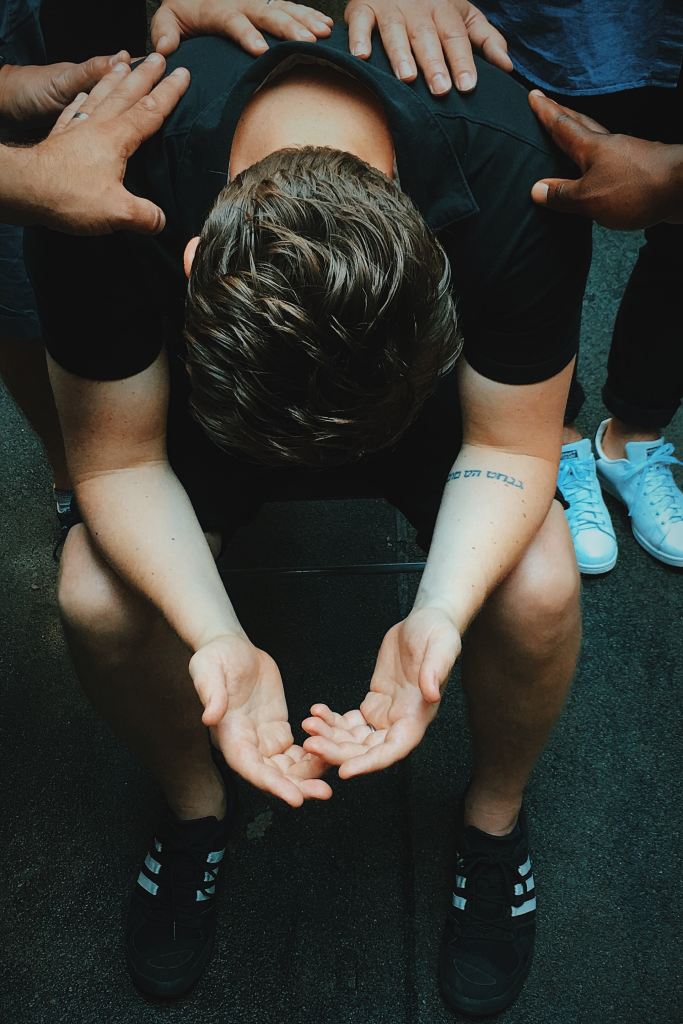
I’d like to take you to 1987, to what looked like a rather grandiose church hall in leafy Surrey Hills. This affluent suburb in Melbourne, Australia, is where I had my exorcism. Or at least my most dramatic one.
I was 25, a participant in a Pentecostal missionary training course; gay, and desperately wanting not to be. Society told me that I was sick, and the church had a solution for that sickness. In that session, the preacher placed one hand on my forehead, while the other was lifted to the ceiling in the style of Pentecostal prayer. He beseeched God, and commanded the demon of homosexuality to leave me. Many people were speaking in tongues and it was like an old revival meeting. My head did not spin around 360 degrees like in the film, The Exorcist. I did not projectile vomit. But I really wanted this to work. Maybe involuntarily, I coughed and had the sensation of something leaving my body. The mind is a very powerful thing.
The preacher then prayed for me reassuringly that I might now live a wholesome life, free from the lust for men that had beset me as a young married Christian man.
Trouble was, that feeling that something had happened was short-lived, and I just went on being gay. The exorcism, or prayer for deliverance to use the more prosaic term, did not work. Not that time. Not any. My efforts, and those of others, to change my sexual orientation over ten years came to naught. They have been labelled conversion therapies, but they neither converted my sexuality, nor were they therapeutic.
—
Not all of my efforts were about casting out demons. Often it would simply be praying and asking God to make me straight. For years, in corporate prayer meetings, at conferences, in one on one mentoring sessions, on the sidelines of delivering presentations at churches, and over and over and over again in my personal prayers, I prayed and asked others to pray for me, that I may no longer be gay.
Over time, the trope of demonic oppression faded from prominence, and made way for something more benign, and more sinister. When mainstream psychology and psychiatry finally moved away from classifying homosexuality as a mental illness, the church created a myth that it was as a result of childhood trauma, overbearing mothers, absent fathers, and lifestyle choices. So, the prayers and therapies took on a pseudo-psychological bent, while still emphasising personal morality and chastity. “Father God, please draw close to Anthony in his heart, that he may know he is deeply loved by his heavenly Father and not need to look to men for affection. Heal this childhood wound where his father did not show him the love he craved. Fill him up with your Holy Spirit, like in the days of Pentecost, so he may be able to resist temptation, and walk with purity.”
While I did live a life of heteronormativity, and did not engage in any sexual activity with men, eventually I gave it up as fruitless: all the renouncing of my attraction to men; all the praying in tongues to be healed; all the reading of books on the reasons why I was gay; all the fake it ‘til you make it standing-up-straight-with-my-hands-by-my-sides-pushing-my-chest-out; and all the intense meditation on Jesus as ‘the divine lover’ – very very homoerotic now I think about it.
—
Having grown up in the Uniting Church, I only encountered the denouncing of homosexuality from the pulpit when I joined conservative evangelical Christian organisations at university, and later as a young adult. I went along with the focus on individual morality, understood through a very literal reading of Scripture, and the lens of seeing one’s issues and problems as caused by past traumas or sins. In the more extreme settings, which I experienced for a number of years, I regularly disclosed my most private thoughts and moral struggles to those in leadership, and they told me how I should live, think and be.
I willingly submitted myself to this regular crossing of boundaries, because I wanted to do and be what (I thought) the Bible said. I wanted my sexuality to be acceptable and I wanted to be normal. I subscribed to the myths that my sexuality was broken and I could be healed – I needed to be healed. I had huge amounts of internalised homophobia that had come from my culture, my schooling, and my family of origin, and the church traded on that homophobia. I hated being gay and I was willing to do anything to change that. The church agreed that I was sick and then offered me a cure that did not work but only made me sicker.
I am lucky that all this conversion therapy did not do me more direct harm. I did not contemplate harming myself as others have done, and I maintained my Christian faith despite it all. It took me about ten years to accept that I was gay and nothing was going to change it. It took about another ten to embrace and enjoy it as who I was, though I never acted on it.
In those twenty or so years I had so much unlearning to do. I felt judged. I felt broken, sick, wrong, unacceptable. Without realising it I was very deeply resentful and unhappy for many years, and I took that resentment and unhappiness out on those closest to me, and caused them great pain. I hold the evangelical church partly responsible, as I struggle with the enormous impact of these lies on what many call the best years of my life.
—
Most days now, I am well and at peace with myself. The trauma is mostly long-forgotten, but from time to time it surfaces. I’ll finish with two examples.
One, was a long email conversation I had earlier this year with a pastor of a huge evangelical church in Melbourne. I had sent an open letter denouncing conversion therapy to a number of pastors and he was the only one who responded. He was very pleasant and pastoral, but it became clear that he was peddling the newly minted line of evangelicals: it’s ok to be gay; and conversion therapy is highly unethical. But the Bible says that God will judge us all, and acting on homosexual orientation is clearly sin. For such people, chastity or abstinence is the only alternative, and there are wonderful examples of nourishing communities of friendship that sustain gay abstaining Christians. Ugh. He helpfully included all the relevant Bible verses decrying homosexuality, just in case I’d forgotten them. I hadn’t, and being sent them unbidden felt like a body blow. I realised that it was not safe for me to keep engaging with him, and I ended our conversation.
The second was more surprising. In October last year, my partner Owen and I saw Layla and Majnun, the Middle Eastern dance production for the Melbourne International Arts Festival. The music and dance were captivating but the narrative left me traumatised. I encountered the ancient love story of hero and heroine as being one where there was woman, there was man, and there was God. And God was in, over, below and around the love between the woman and the man. God endorsed and approved of the love of the woman and the man. As I watched I was taken to all the years where I heard over and over that God only endorsed and approved of heterosexual love. Everything else was abominable. Only straight love was acceptable. How I was motivated at my deepest level was not acceptable.
I am well, but I am scarred.

 Particularity