This presentation was delivered to an IDAHOBIT event (International Day against Homophobia, Biphobia, Intersex-phobia and Transphobia) at Melton City Council in Melbourne, Victoria, Australia in 2022.
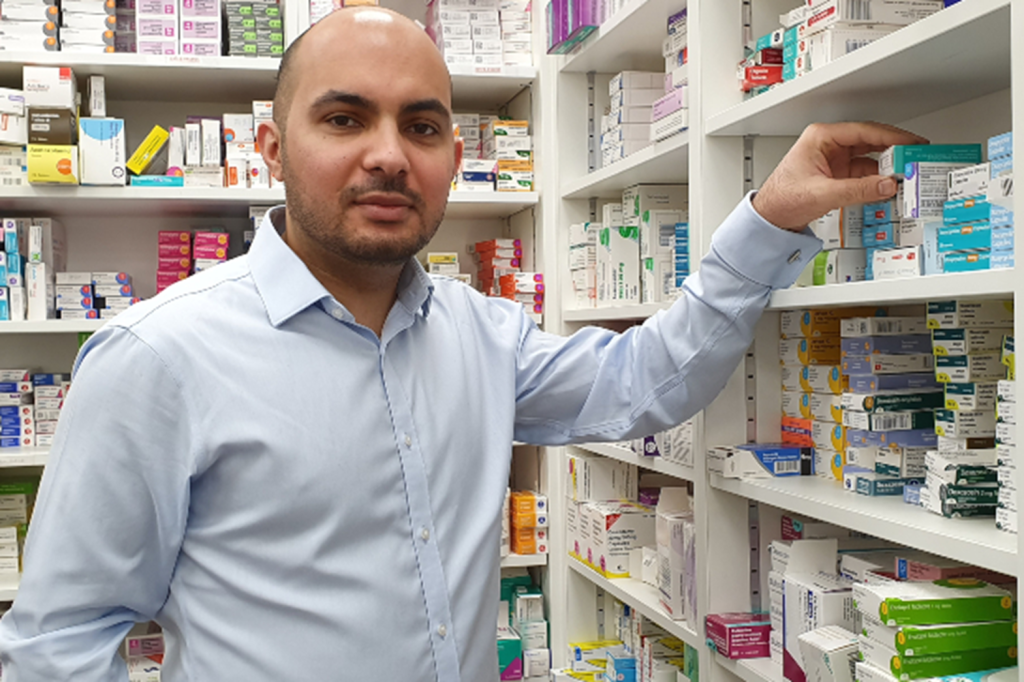
The other day I went to our local pharmacy.
Now that I have turned 60 and my partner Owen is nearly 65, much to my bemusement that I am turning into my parents, it’s a regular occurrence.
They’re a small local business, and the staff and pharmacists know us both by sight, but not quite by name. But we’re sure they know that we’re a couple.
I handed over two scripts for Owen with his surname on them, then said that I wanted one for me that they had on file under my name, Anthony.
The pharmacist looked at me as if he should know the answer and said, ‘Same surname?’
I smiled inwardly, because while Owen and I are engaged, we’re not married and we’re very unlikely to change our names if we do.
But I thought it was just so sweet that the pharmacist thought that just maybe we had not only tied the knot, but tied our names.
When your local community treats you and your relationship as unexceptional, and with everyday kindness and respect: THIS is what LGBTIQA+ inclusion looks like.
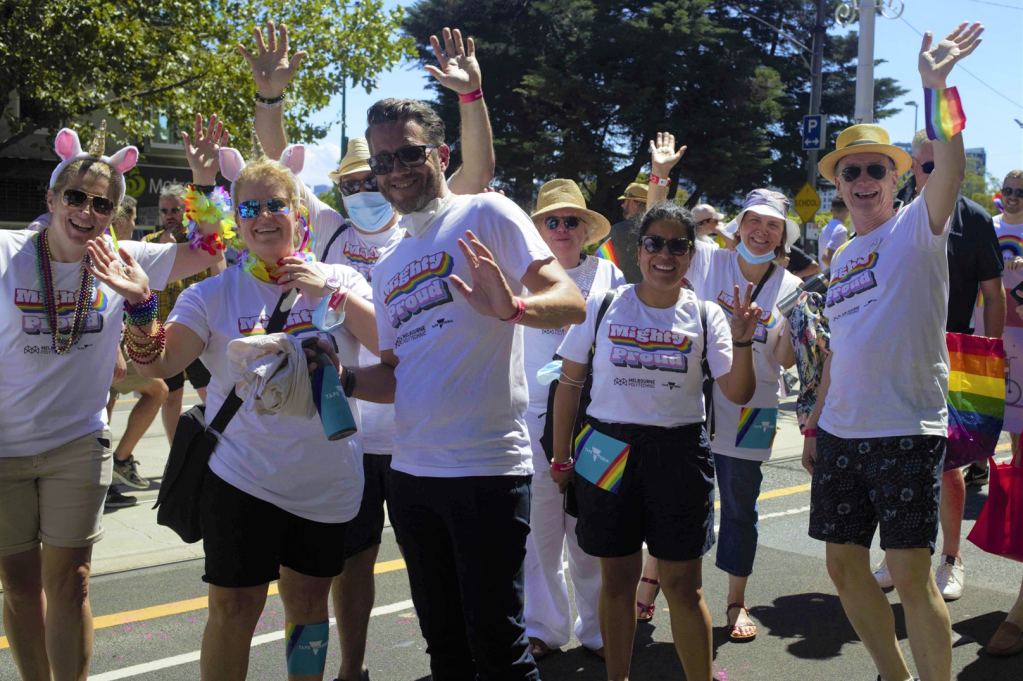
On 6 February this year, I marched with work colleagues in the Midsumma Pride March down Fitzroy St, St Kilda.
We wore specially designed Mighty Proud Melbourne Polytechnic T-shirts, and not only did our CEO and Board Chair march with us, but we were part of a contingent of Victorian TAFEs, proudly led by a State Government MP.
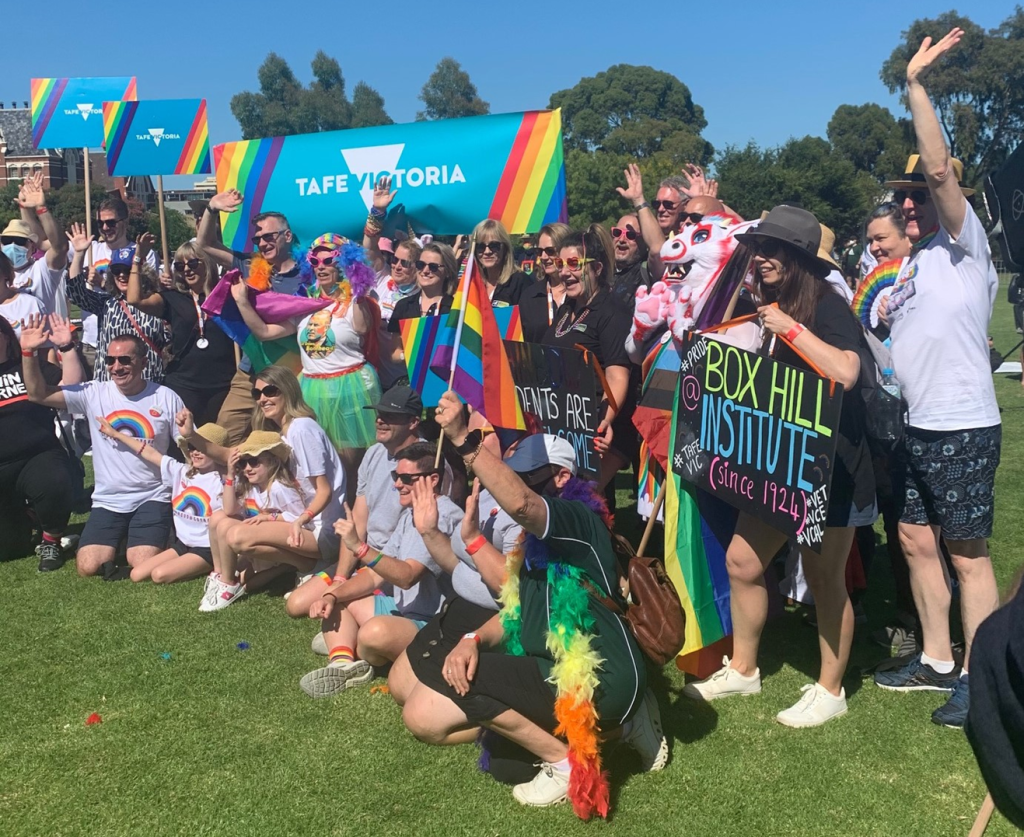
It never gets old to walk down the street festooned with rainbows as far as the eye can see and have people clap and cheer about you being gay rather than hurl insults.
When your workplace and your sector stand with you and walk with you in pride, and when broader society says we love having you as part of the fabric of our lives: THIS is what LGBTIQA+ inclusion looks like.
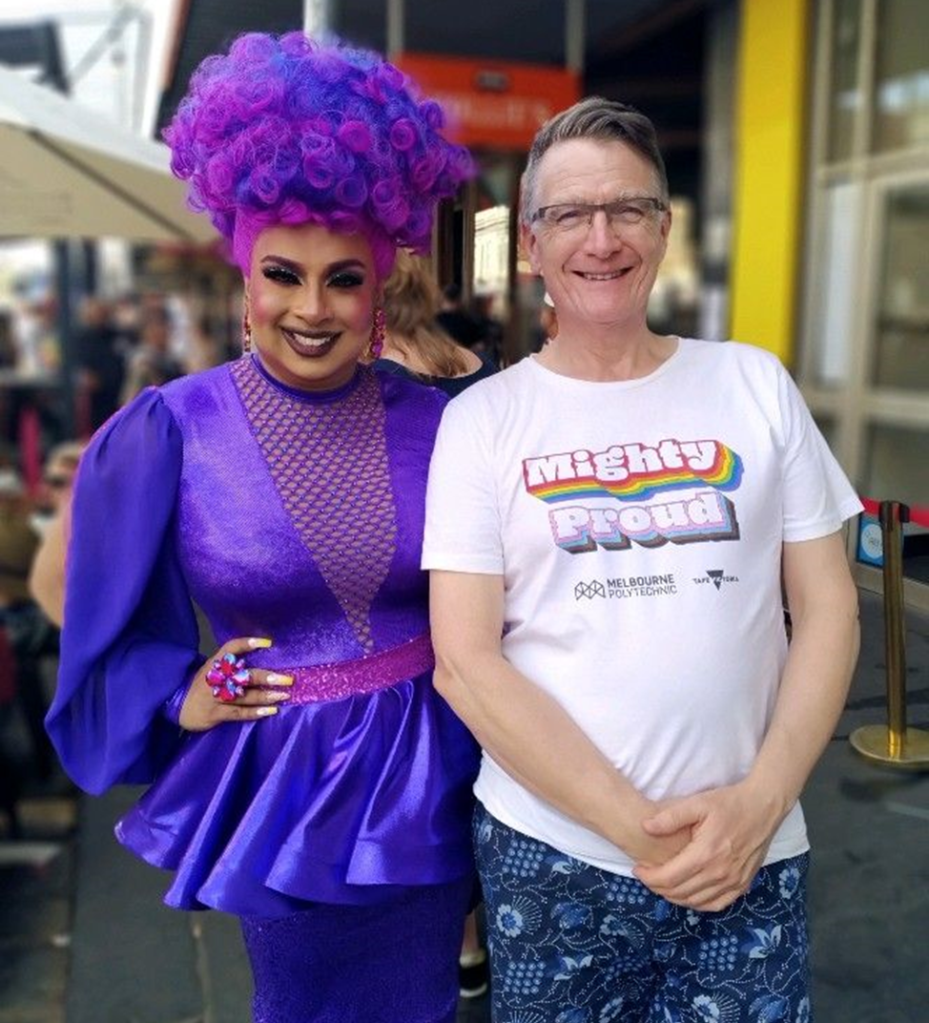
A week later, Owen and I attended the Melbourne Pride Street Party, organised by the State Government to mark 40 years of decriminalisation of homosexuality in Victoria.
This is me with one of the girls outside Molly’s Bar in Smith St.
It was a truly awesome event, with thousands of lesbians, gays, bisexuals, trans people, intersex people, queer people, asexual people, and our allies, strolling up and down Smith and Gertrude Streets in Fitzroy, soaking up the sun, stalls, sideshows, styles and smarts of a celebration of freedom and diversity.
I decided it would be cool to wear my Mighty Proud T-shirt to the Street Party, but that’s because of COVID and being out of the scene for over a year and so out of practice for events like this.
What a missed opportunity! I wish now that I could show you a photo of me in my black kilt, my black Doc Martens with straps ,and my black studded leather accessories, all of which are at home gathering dust, but no, here I am in my corporate T-shirt!
But this photo was a great success on my LinkedIn account, viewed over 1600 times. In my post, I talked about my passion for LGBTIQA+ inclusion in the workplace, which is a side project to my main job in gender equality and Family Violence prevention.
When the government not only acknowledges your existence and your rights, and addresses past injustices, it marks key events with civic pride and generous funding, and when being gay is part of your brand that you cultivate on social media: THIS is what LGBTIQA+ inclusion looks like.
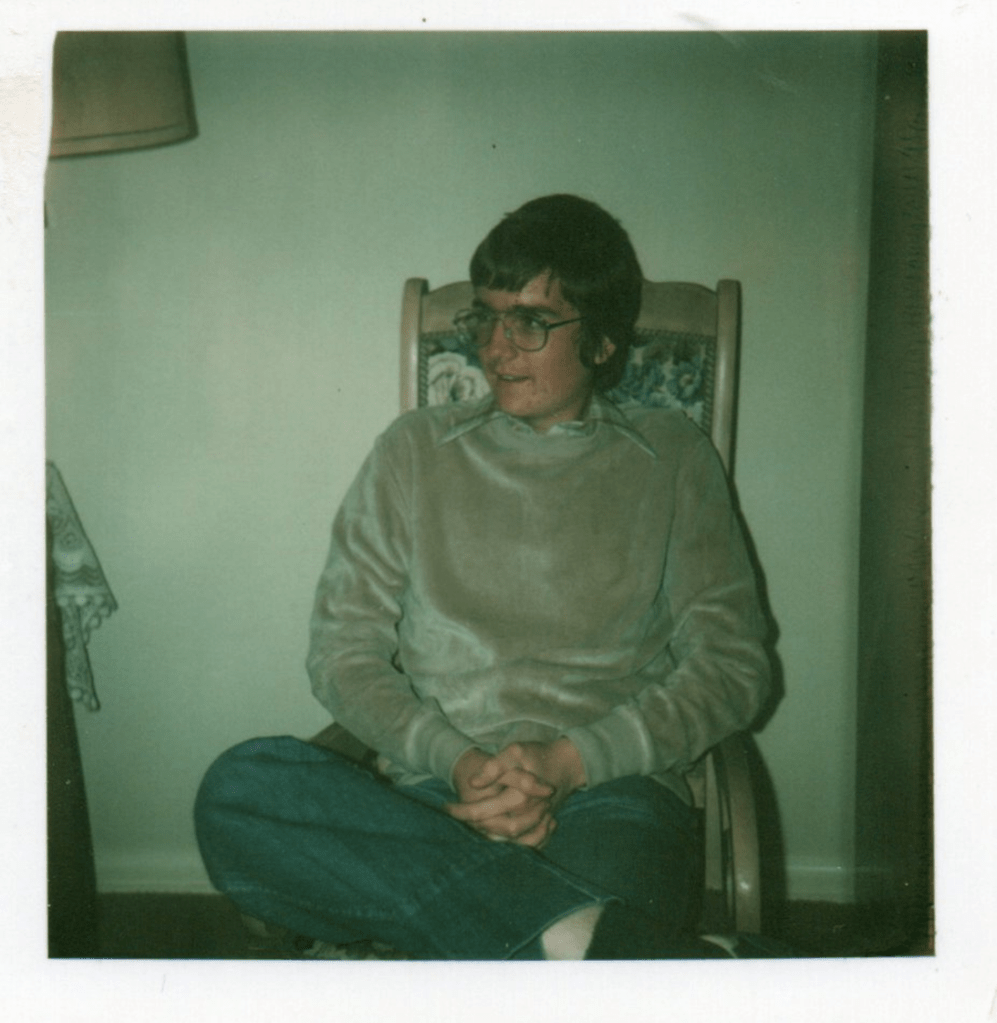
However, when I was young, it was a very different story.
From the 60s into the 80s, school, society and family were all thoroughly homophobic.
As a soft and effeminate boy attending a hyper-masculine single-sex school, I was teased, belittled and abused as a cissy and a poofter.
My society told me that I was a freak by providing no positive role models, in fact no representation at all, in popular culture.
There was no Queer Eye or The L Word, and in my formative years I felt that my experience of liking boys and men must be wrong because no one was making music, television or film to show me otherwise.
And as for family, when my older brother came out as gay in a letter to my parents when I was 18, my mother’s screams of anguish slammed the lid down shut on any sense of homosexuality being acceptable, causing me only to double down on oppressing my sexuality.
When young people are told that the emerging senses that they have about themselves are wrong, sick or hideous, and when those who should be protecting and supporting them as they grow and develop are absent, hostile or caught up in some kind of moral panic: THAT is what LGBTIQA+ discrimination looks like.
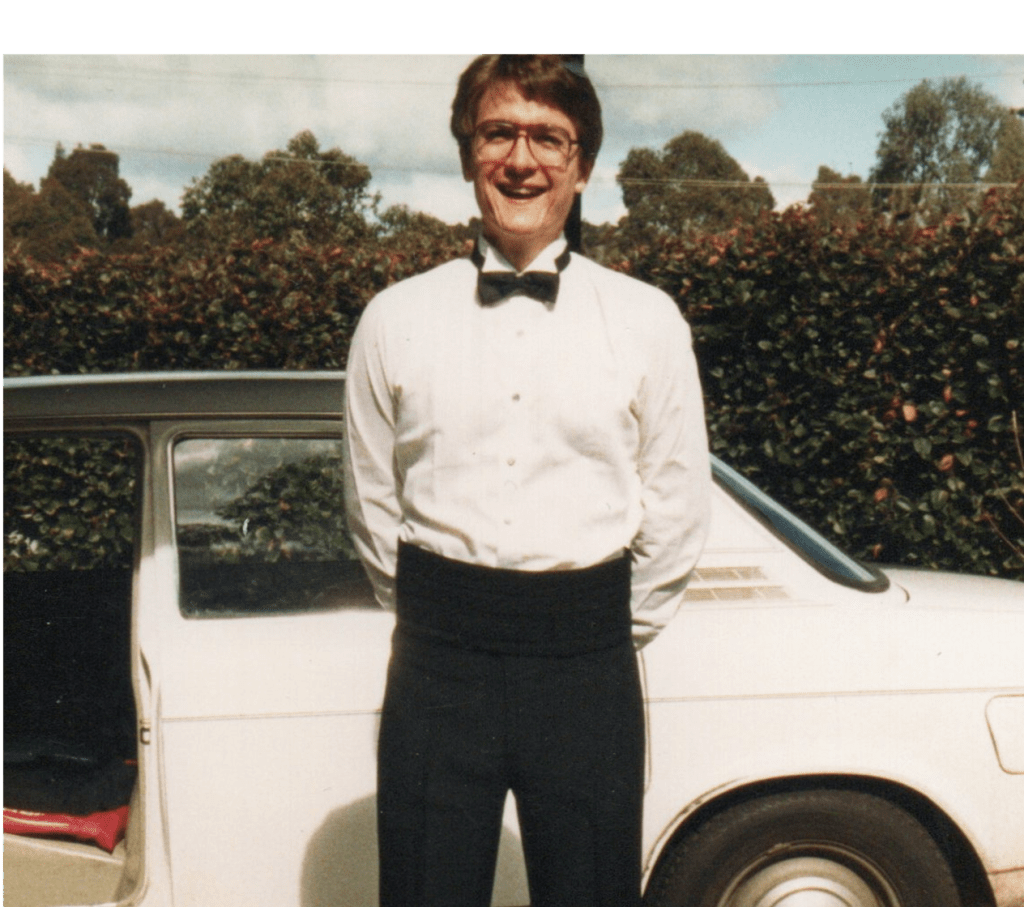
So, what does any self-loathing young gay conservative Christian man do in his early 20s?
He gets married to a woman, of course.
My evangelical spiritual leaders told me that I need not fear, as I could be cured of the demon of homosexuality.
In the mission organisation that I joined with my wife, where we lived and worked as volunteers for 14 years, I subjected myself to what is now called LGBT conversion therapy, which has wonderfully now been outlawed in Victoria.
For years, I tried to change my sexual orientation by my own study and prayer, by being prayed over by others, by speaking in tongues, by publicly renouncing my attraction to men, by disclosing to leaders when I had impure thoughts, by strictly controlling my thought life, by praying that God would ‘re-parent’ me to correct so-called psychological developmental aberrations, and by subjecting myself to numerous exorcisms, all to no avail.
When spiritual leaders abuse the trust that is put in them, when those in authority use pseudo-science to oppress the marginalised, and when people are convinced that they are broken, sick or in need of healing just for who they love and how they identify: THAT is what LGBTIQA+ discrimination looks like.
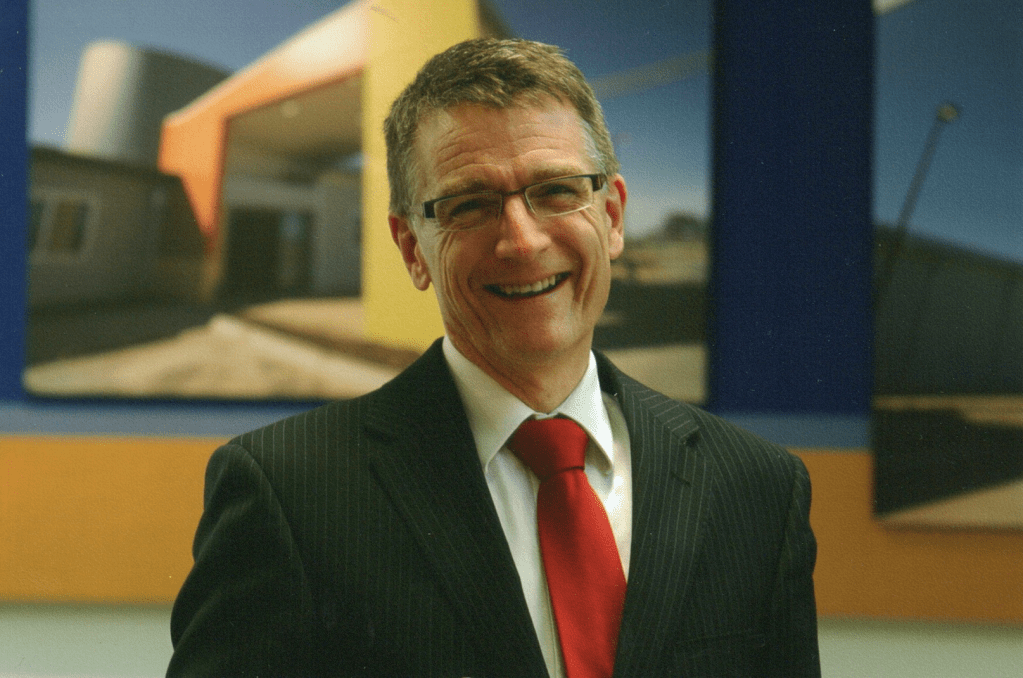
In 2008, my world underwent a massive, seismic shift.
I had not long started my job here at Melton City Council. My wife and I had left the Christian mission in 2000 with no savings, no super and no assets and we were gradually rebuilding our lives.
I was realising more and more that the mission had been pretty much a cult, and that the behaviour of its leaders amounted to spiritual abuse.
One day in 2008, I was standing in our beige Laminex kitchen, thinking about how sometimes people who have been abused themselves become abusers, and an awful, sickening thought dropped into my mind.
All those years when my wife had told me that she had hated living in the mission, all those times when she had begged that we might leave and I had told her that no, it was God’s will and it would all be ok, all those times when I had exerted power and control over her life – I was a victim of spiritual abuse that had become an emotional abuser.
When people who are repressed and damaged turn around and repress and damage others, when those who are denied freedom to be themselves grow up stunted and dysfunctional: THAT is what LGBTIQA+ discrimination looks like.
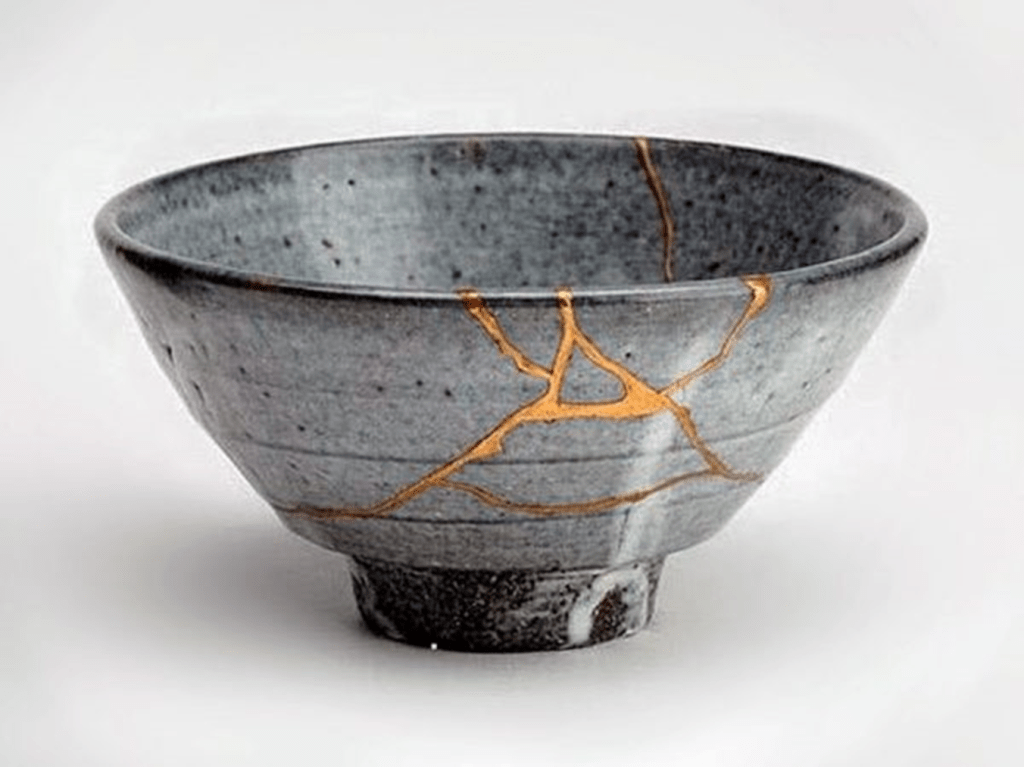
https://austinkleon.com/2019/12/22/kintsugi-and-the-art-of-making-repair-visible
Discrimination does not always determine tragedy, and scars can become a thing of beauty.
Kintsugi is the Japanese art of mending broken ceramics with gold, to make something beautiful that celebrates the repair, and to acknowledge that life is full of imperfections and second chances.
My journey of reparation for the damage I’ve done to others, and learning to understand how pervasive is men’s power over women, has led me to pursue a new career in gender equality and Family Violence prevention.
My lifetime of learning to accept, love and celebrate the fact that I just love men has led me to be a passionate advocate for lesbian, gay, bisexual, trans, intersex, queer and asexual rights, and return to study Gender and Sexuality at Deakin University.
What might my life have looked like if I had not faced such discrimination in the first place? What if I had been born much later?
Dwelling on this is ultimately unhelpful; we can’t change the past and the future doesn’t exist – we have only the present.
Plus, I am incredibly grateful for the life I’ve led so far, the children and grandchildren I love now, and my wonderful partner, Owen.
I know I lead a privileged existence. LGBTIQA+ people in many Australian communities and in many countries still face real life and death discrimination, as do many refugees and people seeking asylum here.
Discrimination is still a live human rights issue today, in Australia.
Inclusion is not about tolerating lifestyles.
It’s about making space for people to live their lives and be normal, ordinary human beings with as few scars as possible. Sometimes, in the case of our most vulnerable young people, it’s about preserving life itself.
Let’s all tear down LGBTIQA+ discrimination, in all its forms.
Let’s all build LGBTIQA+ inclusion.

 Particularity