Inclusion and discrimination

This presentation was delivered to an IDAHOBIT event (International Day against Homophobia, Biphobia, Intersex-phobia and Transphobia) at Melton City Council in Melbourne, Victoria, Australia in 2022.

https://www.chemistanddruggist.co.uk/feature/boosting-independents-digital-presence-award-winning-website

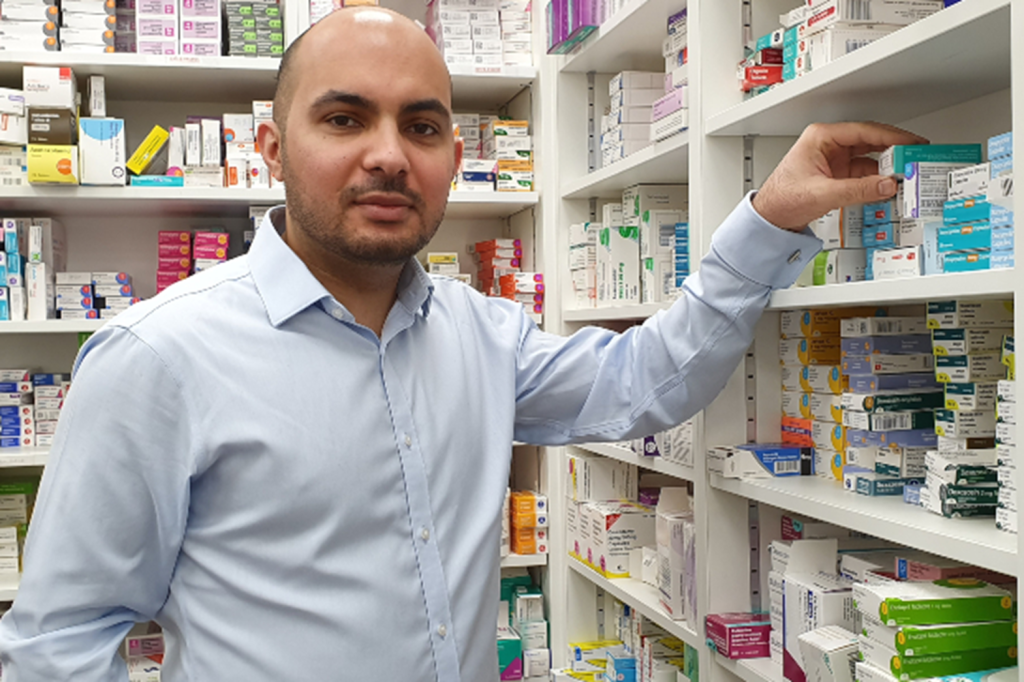
The other day I went to our local pharmacy.

Now that I have turned 60 and my partner Owen is nearly 65, much to my bemusement that I am turning into my parents, it’s a regular occurrence.

They’re a small local business, and the staff and pharmacists know us both by sight, but not quite by name. But we’re sure they know that we’re a couple.

I handed over two scripts for Owen with his surname on them, then said that I wanted one for me that they had on file under my name, Anthony.

The pharmacist looked at me as if he should know the answer and said, ‘Same surname?’

I smiled inwardly, because while Owen and I are engaged, we’re not married and we’re very unlikely to change our names if we do.

But I thought it was just so sweet that the pharmacist thought that just maybe we had not only tied the knot, but tied our names.

When your local community treats you and your relationship as unexceptional, and with everyday kindness and respect: THIS is what LGBTIQA+ inclusion looks like.

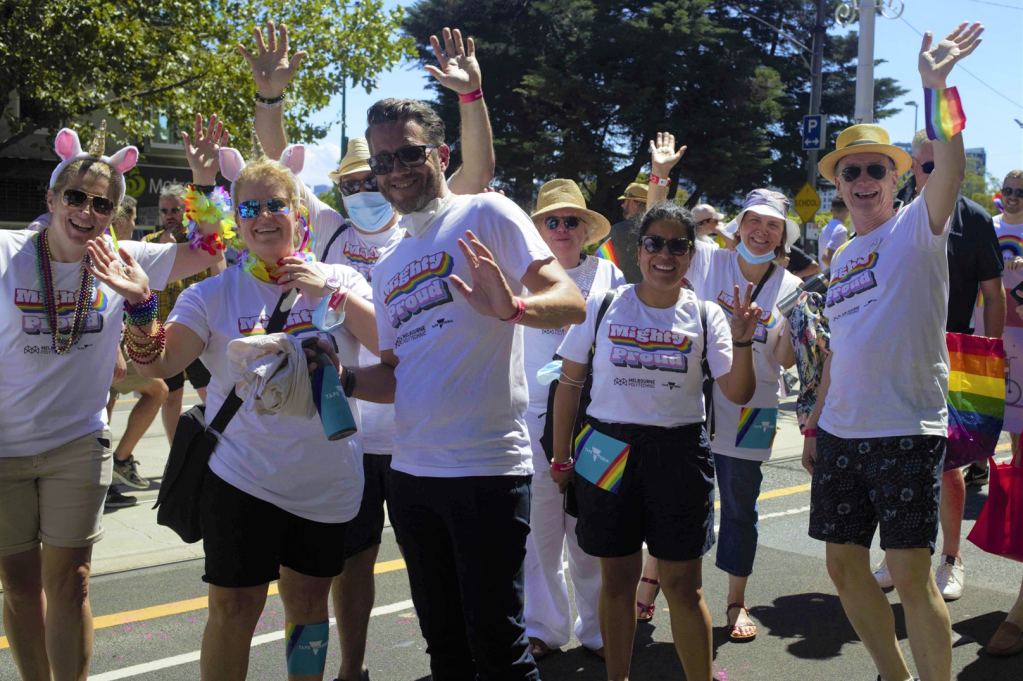
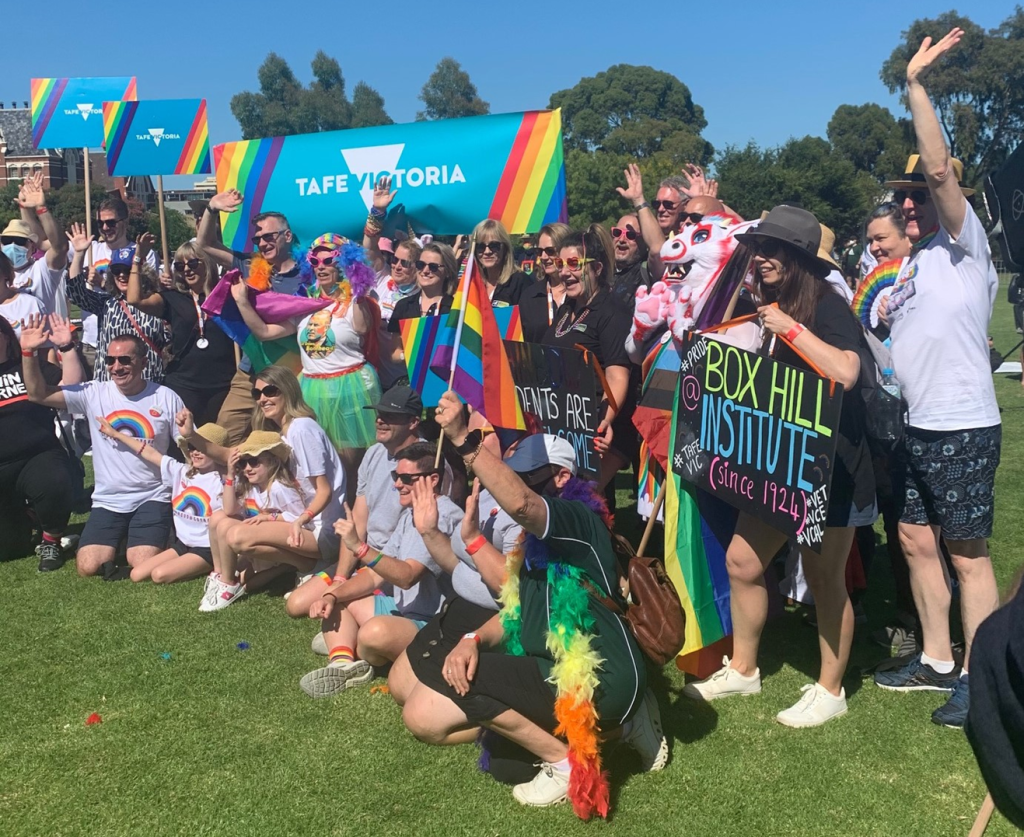
On 6 February this year, I marched with work colleagues in the Midsumma Pride March down Fitzroy St, St Kilda.

We wore specially designed Mighty Proud Melbourne Polytechnic T-shirts, and not only did our CEO and Board Chair march with us, but we were part of a contingent of Victorian TAFEs, proudly led by a State Government MP.

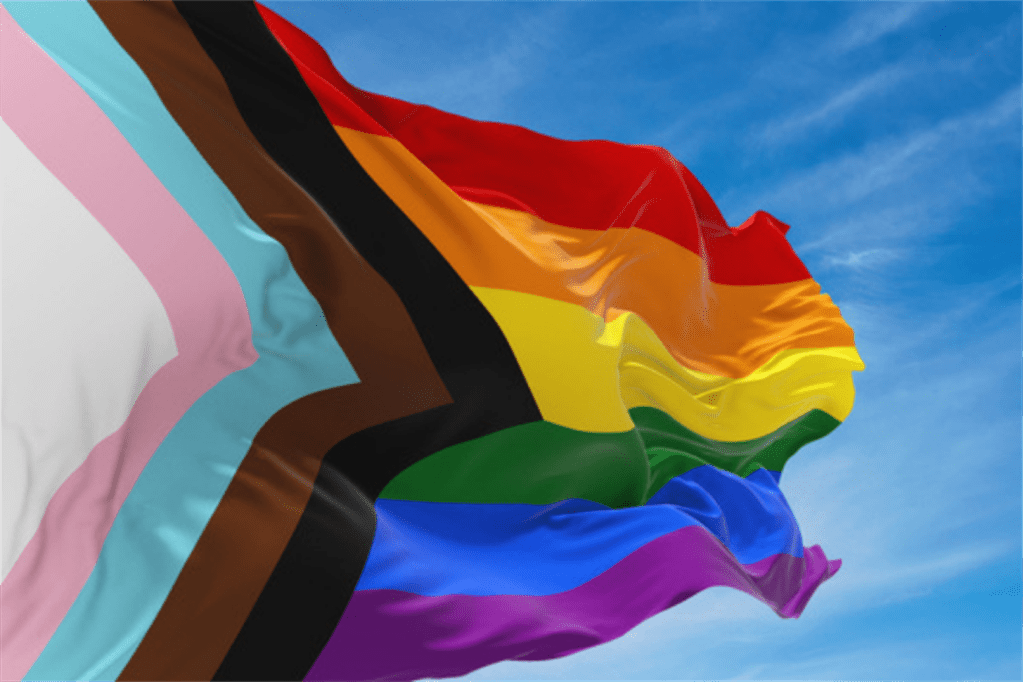
It never gets old to walk down the street festooned with rainbows as far as the eye can see and have people clap and cheer about you being gay rather than hurl insults.

When your workplace and your sector stand with you and walk with you in pride, and when broader society says we love having you as part of the fabric of our lives: THIS is what LGBTIQA+ inclusion looks like.

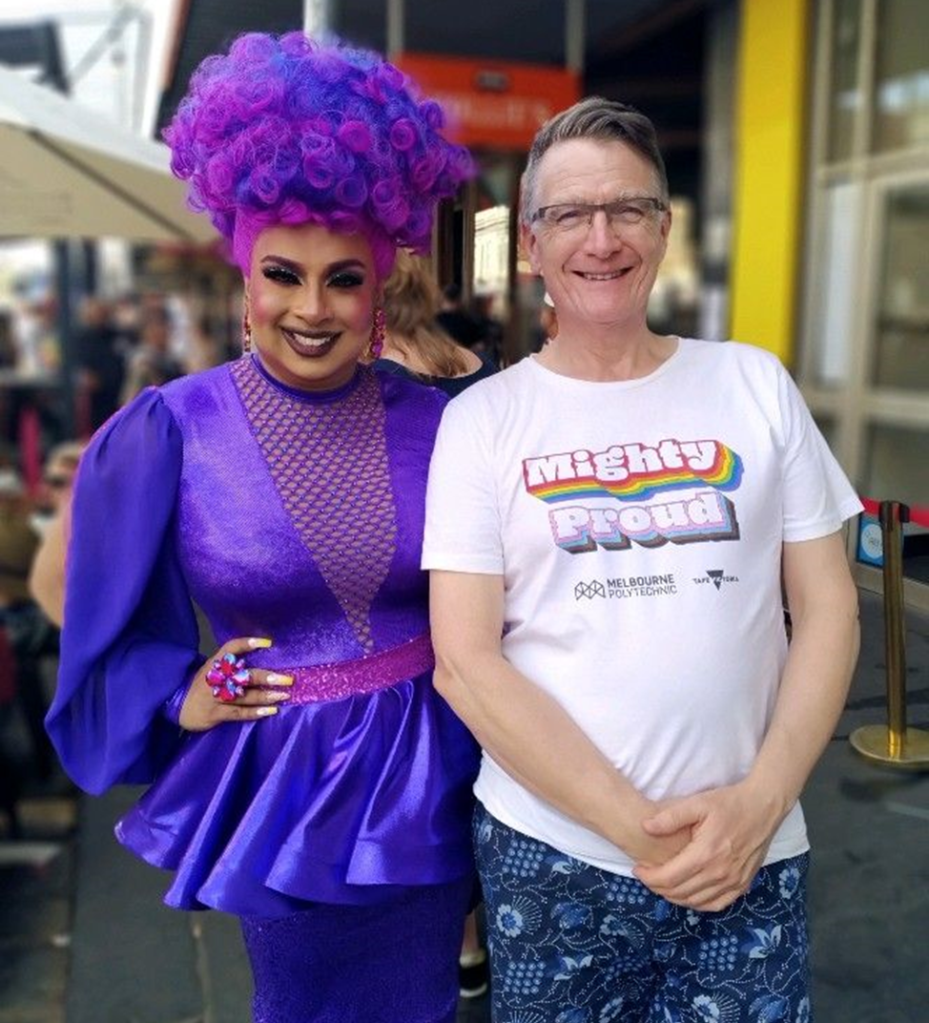
A week later, Owen and I attended the Melbourne Pride Street Party, organised by the State Government to mark 40 years of decriminalisation of homosexuality in Victoria.

This is me with one of the girls outside Molly’s Bar in Smith St.

It was a truly awesome event, with thousands of lesbians, gays, bisexuals, trans people, intersex people, queer people, asexual people, and our allies, strolling up and down Smith and Gertrude Streets in Fitzroy, soaking up the sun, stalls, sideshows, styles and smarts of a celebration of freedom and diversity.

I decided it would be cool to wear my Mighty Proud T-shirt to the Street Party, but that’s because of COVID and being out of the scene for over a year and so out of practice for events like this.

What a missed opportunity! I wish now that I could show you a photo of me in my black kilt, my black Doc Martens with straps ,and my black studded leather accessories, all of which are at home gathering dust, but no, here I am in my corporate T-shirt!

But this photo was a great success on my LinkedIn account, viewed over 1600 times. In my post, I talked about my passion for LGBTIQA+ inclusion in the workplace, which is a side project to my main job in gender equality and Family Violence prevention.

When the government not only acknowledges your existence and your rights, and addresses past injustices, it marks key events with civic pride and generous funding, and when being gay is part of your brand that you cultivate on social media: THIS is what LGBTIQA+ inclusion looks like.

However, when I was young, it was a very different story.

From the 60s into the 80s, school, society and family were all thoroughly homophobic.

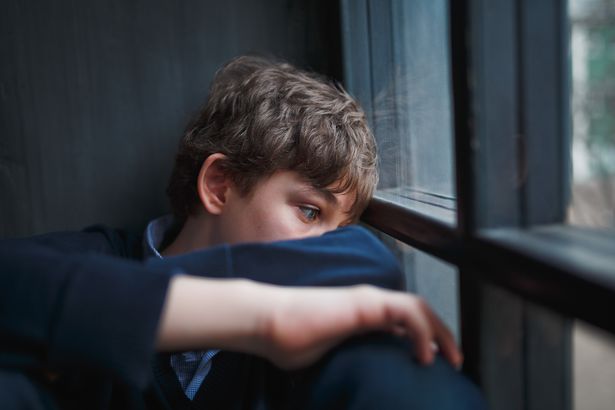
As a soft and effeminate boy attending a hyper-masculine single-sex school, I was teased, belittled and abused as a cissy and a poofter.

My society told me that I was a freak by providing no positive role models, in fact no representation at all, in popular culture.

There was no Queer Eye or The L Word, and in my formative years I felt that my experience of liking boys and men must be wrong because no one was making music, television or film to show me otherwise.

And as for family, when my older brother came out as gay in a letter to my parents when I was 18, my mother’s screams of anguish slammed the lid down shut on any sense of homosexuality being acceptable, causing me only to double down on oppressing my sexuality.

When young people are told that the emerging senses that they have about themselves are wrong, sick or hideous, and when those who should be protecting and supporting them as they grow and develop are absent, hostile or caught up in some kind of moral panic: THAT is what LGBTIQA+ discrimination looks like.

So, what does any self-loathing young gay conservative Christian man do in his early 20s?

He gets married to a woman, of course.

My evangelical spiritual leaders told me that I need not fear, as I could be cured of the demon of homosexuality.

In the mission organisation that I joined with my wife, where we lived and worked as volunteers for 14 years, I subjected myself to what is now called LGBT conversion therapy, which has wonderfully now been outlawed in Victoria.

For years, I tried to change my sexual orientation by my own study and prayer, by being prayed over by others, by speaking in tongues, by publicly renouncing my attraction to men, by disclosing to leaders when I had impure thoughts, by strictly controlling my thought life, by praying that God would ‘re-parent’ me to correct so-called psychological developmental aberrations, and by subjecting myself to numerous exorcisms, all to no avail.

When spiritual leaders abuse the trust that is put in them, when those in authority use pseudo-science to oppress the marginalised, and when people are convinced that they are broken, sick or in need of healing just for who they love and how they identify: THAT is what LGBTIQA+ discrimination looks like.

In 2008, my world underwent a massive, seismic shift.

I had not long started my job here at Melton City Council. My wife and I had left the Christian mission in 2000 with no savings, no super and no assets and we were gradually rebuilding our lives.

I was realising more and more that the mission had been pretty much a cult, and that the behaviour of its leaders amounted to spiritual abuse.

One day in 2008, I was standing in our beige Laminex kitchen, thinking about how sometimes people who have been abused themselves become abusers, and an awful, sickening thought dropped into my mind.

All those years when my wife had told me that she had hated living in the mission, all those times when she had begged that we might leave and I had told her that no, it was God’s will and it would all be ok, all those times when I had exerted power and control over her life – I was a victim of spiritual abuse that had become an emotional abuser.

When people who are repressed and damaged turn around and repress and damage others, when those who are denied freedom to be themselves grow up stunted and dysfunctional: THAT is what LGBTIQA+ discrimination looks like.

https://austinkleon.com/2019/12/22/kintsugi-and-the-art-of-making-repair-visible

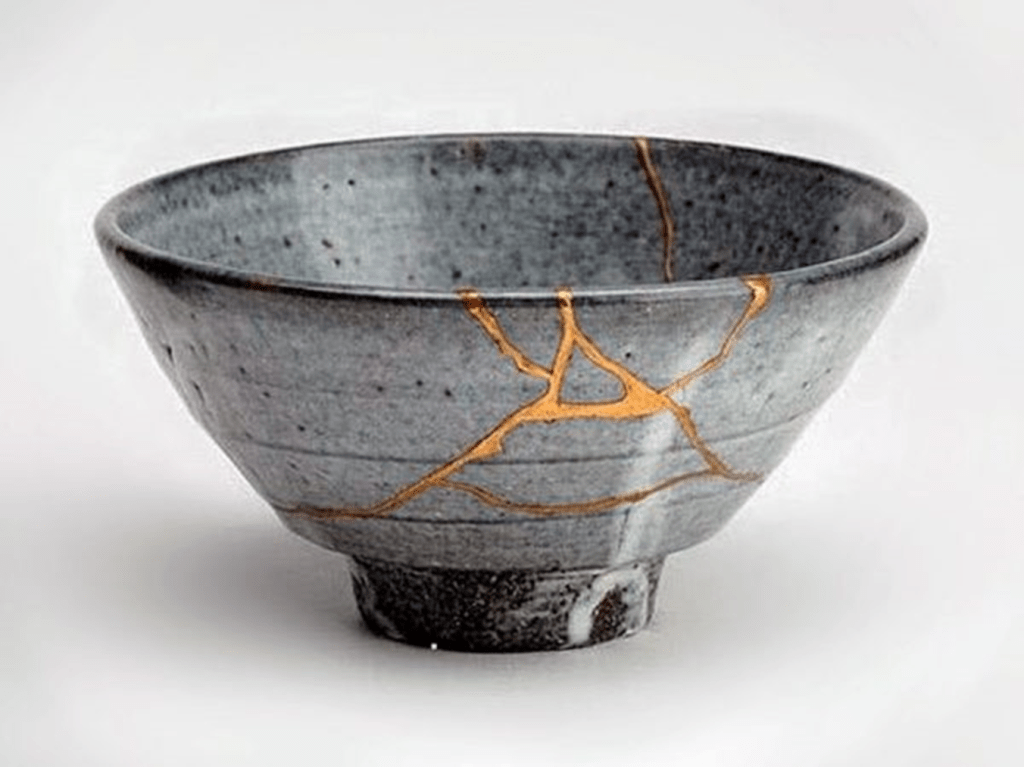
Discrimination does not always determine tragedy, and scars can become a thing of beauty.

Kintsugi is the Japanese art of mending broken ceramics with gold, to make something beautiful that celebrates the repair, and to acknowledge that life is full of imperfections and second chances.

My journey of reparation for the damage I’ve done to others, and learning to understand how pervasive is men’s power over women, has led me to pursue a new career in gender equality and Family Violence prevention.

My lifetime of learning to accept, love and celebrate the fact that I just love men has led me to be a passionate advocate for lesbian, gay, bisexual, trans, intersex, queer and asexual rights, and return to study Gender and Sexuality at Deakin University.

What might my life have looked like if I had not faced such discrimination in the first place? What if I had been born much later?

Dwelling on this is ultimately unhelpful; we can’t change the past and the future doesn’t exist – we have only the present.

Plus, I am incredibly grateful for the life I’ve led so far, the children and grandchildren I love now, and my wonderful partner, Owen.

I know I lead a privileged existence. LGBTIQA+ people in many Australian communities and in many countries still face real life and death discrimination, as do many refugees and people seeking asylum here.

Discrimination is still a live human rights issue today, in Australia.

Inclusion is not about tolerating lifestyles.

It’s about making space for people to live their lives and be normal, ordinary human beings with as few scars as possible. Sometimes, in the case of our most vulnerable young people, it’s about preserving life itself.

Let’s all tear down LGBTIQA+ discrimination, in all its forms.

Let’s all build LGBTIQA+ inclusion.

https://www.maribyrnong.vic.gov.au/Discover-Maribyrnong/Our-culture-and-community/LGBTIQA-People-Families-and-Communities

An open letter to parliamentarians and faith leaders about conversion therapy

Dear brothers and sisters,

In light of the Change or Suppression (Conversion) Practices Prohibition Bill 2020 (Vic), I write that you might consider my story as you review and reassess your views on gay conversion therapy. For most of my 20s I actively and consistently sought God’s help to change my sexual orientation through prayer and ministry.

Born into a conservative evangelical family, I inherited a wonderful faith tradition. My paternal grandfather, and my father, were heavily involved in lay leadership in the Victorian Presbyterian church. For a number of years my father directed stewardship campaigns and was for a time the director of Stewardship and Promotion for the Presbyterian Church of Victoria. My mother came from committed Congregationalist stock and we were a faithful church-attending family.

In my teenage years I made a personal commitment to faith in Jesus Christ, guided by an evangelistic tract written by John Stott. I attended The Avenue Uniting Church Blackburn and my faith grew – I hungered to know God better, and to have Him change and affect every area of my life, my service and my heart. In university I joined Student Life, the Australian arm of Campus Crusade for Christ. I was looking for faith instruction that not only told me how I should live, but also how I might be healed of my emotional scars and hindrances, so that I might achieve that life.

When I was 24 I joined Youth with a Mission or YWAM (with my wife), because they promoted this kind of healing as part of their work to “Know God and Make Him Known”. On reflection I think I was trying to deal with a number of personal emotional issues that included my same-sex attraction. We went through a Discipleship Training School and joined staff, living and working as volunteers in two centres for a total of 14 years. In much of that time I actively sought healing from my homosexuality, as I will outline below.

Because of YWAM’s grounding in the Charismatic tradition, in those years I also experienced prayer for healing from my same-sex attraction in a number of Charismatic and Pentecostal churches and settings. In addition guest speakers attended our centres who would pray for people as part of their ministry.

While at YWAM we also worshipped at St Hilary’s Anglican Church Kew. In time I became a worship leader and a key volunteer and member. I attended every Sunday; the church was a huge part of our social life too. For a number of the 21 years that I was at St Hilary’s, I continued to seek healing from my homosexuality through reading, reflection and prayer.

Much later my wife encouraged us to both participate in a program called Cleansing Streams. By that stage I was not actively seeking to change my sexual orientation, and the program covered a wide range of topics and issues. However, there was prayer for the changing of orientation and I willingly participated, open to whatever God might do for me in that time.

I list these contexts and experiences because I want to outline my religious literacy and spiritual commitment, and show the range of settings in which I actively tried to change my sexual orientation. Below I list the kinds of ministry and interventions in which I participated over nearly ten years:

  • Consistent regular prayer by me for changing my orientation, including through the speaking of tongues
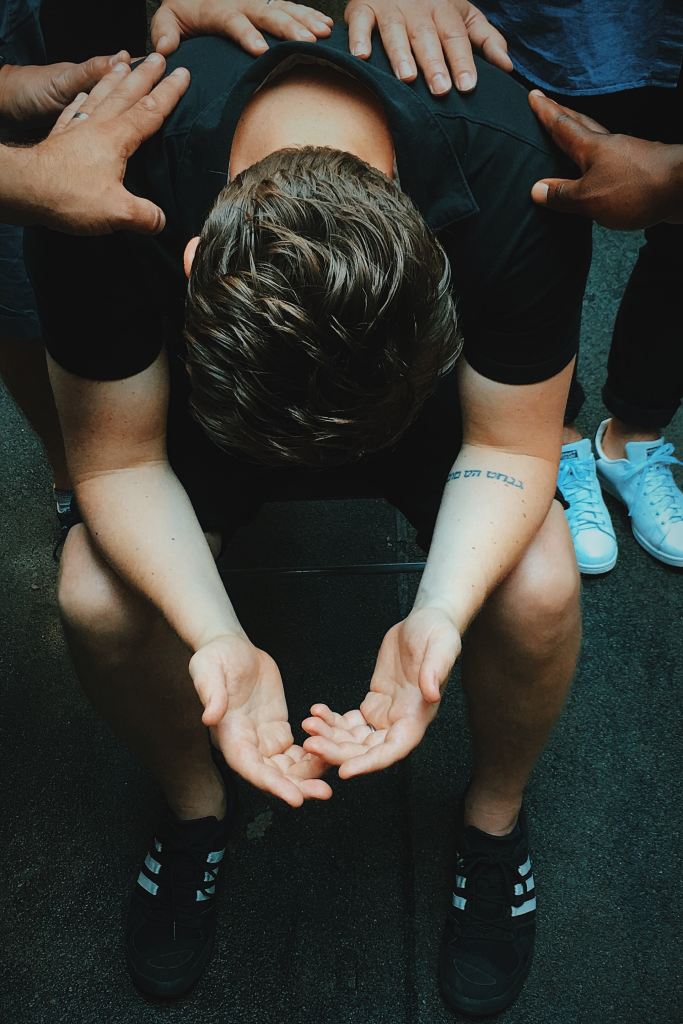
  • Repeated prayer by others for the changing of my sexual orientation, including with the laying on of hands
  • Charismatic prayer ministry for the infilling of the Holy Spirit and the subsequent changing of my orientation
  • My repeated public renunciation of my attraction to men
  • Personal application of the principles of spiritual warfare in relation to the demons of homosexuality
  • Deliverance ministry conducted by others with significant experience in such ministry
  • Prayer by others and self for the ministration of the Father Heart of God
  • Prayer by others and self for my ‘re-parenting’ by God to address the allegedly underlying causes of a ‘dominant mother and absent father’
  • Exhortation by others, adopted by self, to assume physical stances that would send myself positive messages about changing my orientation e.g. standing up straight with hands by the side and chest out – trying to encourage positive feedback loops and ultimately change behaviour and orientation
  • Controlling my thought life through not looking at pornography or any other ‘unhelpful’ images
  • Controlling my thought life through praying each time I had an ‘unclean’ thought
  • Actively seeking and promoting healthy friendships with straight men and being emotionally open and vulnerable with them, and allowing their acceptance and friendship to minister to me
  • Participating in accountability relationships with other men where I would seek help and prayer if I felt I was being tempted in the area of homosexuality
  • Studying books on the psychological causes of homosexuality
  • Through personal prayer, reflection and meditation seeking to allow God to minister to what I believed were unmet needs in childhood related to my relationship with significant authority figures
  • Developing a strong and intimate prayer life with Christ to receive His comfort in the manner some describe as ‘the Divine Lover’.

Please note that at no time before or during my marriage did I act on my homosexual orientation and I enjoyed the full support and comfort of my wife in my struggles.

My exhortation to you is that I tried many, many different strategies, on my own and with learned and mature leaders, with great faith and passion and desire for change – and nothing worked. My sexual orientation did not change. I experienced times where I felt more ‘straight’, but ultimately those feelings were a mirage. I remained, and remain, fundamentally attracted physically and romantically to men. For this reason alone – the lack of efficacy – I implore you to reconsider your belief in the wisdom of these ministries.

But these practices are not only ineffective, they are harmful. I did a huge amount of psychological damage to myself, and allowed others to do damage to me. The message I sent myself was that a massive and core part of me was unacceptable, and it took me years to recover. Amazingly I kept my Christian faith through it, but I take this to be a miracle when I consider what the outcome might have been.

What about Scripture? How can we neglect what the Bible says? I am not a theologian so I will not attempt to answer this, except to say that my faith in the truth of The Word was a key driver for my many years of trying to change my orientation. In years hence I have been able to reconcile the two.

But you don’t know me, and you have only my word in this letter to attest to my faith and my faithfulness. Do you know many gay people? Ones who have come to love and accept who they are? What about gay Christians who are healthy and happy? There are many, and when you come to know them you may realise that the fruit of their lives does in fact show the infilling of the Spirit, the ongoing work of Christ, and the love of God. You might get to know me – I would love to meet you and for you to get to know this happy and healthy gay person of deep spirituality. 

As gay conversion therapy has only brought me pain and harm, and has not changed my sexual orientation, I implore you to reconsider your support for it.

Please pass the Change or Suppression (Conversion) Practices Prohibition Bill 2020.

Thank you.

I am well, but I am scarred

Photo by Jon Tyson on Unsplash

I’d like to take you to 1987, to what looked like a rather grandiose church hall in leafy Surrey Hills. This affluent suburb in Melbourne, Australia, is where I had my exorcism. Or at least my most dramatic one.

I was 25, a participant in a Pentecostal missionary training course; gay, and desperately wanting not to be. Society told me that I was sick, and the church had a solution for that sickness. In that session, the preacher placed one hand on my forehead, while the other was lifted to the ceiling in the style of Pentecostal prayer. He beseeched God, and commanded the demon of homosexuality to leave me. Many people were speaking in tongues and it was like an old revival meeting. My head did not spin around 360 degrees like in the film, The Exorcist. I did not projectile vomit. But I really wanted this to work. Maybe involuntarily, I coughed and had the sensation of something leaving my body. The mind is a very powerful thing.

The preacher then prayed for me reassuringly that I might now live a wholesome life, free from the lust for men that had beset me as a young married Christian man.

Trouble was, that feeling that something had happened was short-lived, and I just went on being gay. The exorcism, or prayer for deliverance to use the more prosaic term, did not work. Not that time. Not any. My efforts, and those of others, to change my sexual orientation over ten years came to naught. They have been labelled conversion therapies, but they neither converted my sexuality, nor were they therapeutic.

Not all of my efforts were about casting out demons. Often it would simply be praying and asking God to make me straight. For years, in corporate prayer meetings, at conferences, in one on one mentoring sessions, on the sidelines of delivering presentations at churches, and over and over and over again in my personal prayers, I prayed and asked others to pray for me, that I may no longer be gay.

Over time, the trope of demonic oppression faded from prominence, and made way for something more benign, and more sinister. When mainstream psychology and psychiatry finally moved away from classifying homosexuality as a mental illness, the church created a myth that it was as a result of childhood trauma, overbearing mothers, absent fathers, and lifestyle choices. So, the prayers and therapies took on a pseudo-psychological bent, while still emphasising personal morality and chastity. “Father God, please draw close to Anthony in his heart, that he may know he is deeply loved by his heavenly Father and not need to look to men for affection. Heal this childhood wound where his father did not show him the love he craved. Fill him up with your Holy Spirit, like in the days of Pentecost, so he may be able to resist temptation, and walk with purity.”

While I did live a life of heteronormativity, and did not engage in any sexual activity with men, eventually I gave it up as fruitless: all the renouncing of my attraction to men; all the praying in tongues to be healed; all the reading of books on the reasons why I was gay; all the fake it ‘til you make it standing-up-straight-with-my-hands-by-my-sides-pushing-my-chest-out; and all the intense meditation on Jesus as ‘the divine lover’ – very very homoerotic now I think about it.

Having grown up in the Uniting Church, I only encountered the denouncing of homosexuality from the pulpit when I joined conservative evangelical Christian organisations at university, and later as a young adult. I went along with the focus on individual morality, understood through a very literal reading of Scripture, and the lens of seeing one’s issues and problems as caused by past traumas or sins. In the more extreme settings, which I experienced for a number of years, I regularly disclosed my most private thoughts and moral struggles to those in leadership, and they told me how I should live, think and be.

I willingly submitted myself to this regular crossing of boundaries, because I wanted to do and be what (I thought) the Bible said. I wanted my sexuality to be acceptable and I wanted to be normal. I subscribed to the myths that my sexuality was broken and I could be healed – I needed to be healed. I had huge amounts of internalised homophobia that had come from my culture, my schooling, and my family of origin, and the church traded on that homophobia. I hated being gay and I was willing to do anything to change that. The church agreed that I was sick and then offered me a cure that did not work but only made me sicker.

I am lucky that all this conversion therapy did not do me more direct harm. I did not contemplate harming myself as others have done, and I maintained my Christian faith despite it all. It took me about ten years to accept that I was gay and nothing was going to change it. It took about another ten to embrace and enjoy it as who I was, though I never acted on it.

In those twenty or so years I had so much unlearning to do. I felt judged. I felt broken, sick, wrong, unacceptable. Without realising it I was very deeply resentful and unhappy for many years, and I took that resentment and unhappiness out on those closest to me, and caused them great pain. I hold the evangelical church partly responsible, as I struggle with the enormous impact of these lies on what many call the best years of my life.

Most days now, I am well and at peace with myself. The trauma is mostly long-forgotten, but from time to time it surfaces. I’ll finish with two examples.

One, was a long email conversation I had earlier this year with a pastor of a huge evangelical church in Melbourne. I had sent an open letter denouncing conversion therapy to a number of pastors and he was the only one who responded. He was very pleasant and pastoral, but it became clear that he was peddling the newly minted line of evangelicals: it’s ok to be gay; and conversion therapy is highly unethical. But the Bible says that God will judge us all, and acting on homosexual orientation is clearly sin.  For such people, chastity or abstinence is the only alternative, and there are wonderful examples of nourishing communities of friendship that sustain gay abstaining Christians. Ugh. He helpfully included all the relevant Bible verses decrying homosexuality, just in case I’d forgotten them. I hadn’t, and being sent them unbidden felt like a body blow. I realised that it was not safe for me to keep engaging with him, and I ended our conversation.

The second was more surprising. In October last year, my partner Owen and I saw Layla and Majnun, the Middle Eastern dance production for the Melbourne International Arts Festival. The music and dance were captivating but the narrative left me traumatised. I encountered the ancient love story of hero and heroine as being one where there was woman, there was man, and there was God. And God was in, over, below and around the love between the woman and the man. God endorsed and approved of the love of the woman and the man. As I watched I was taken to all the years where I heard over and over that God only endorsed and approved of heterosexual love. Everything else was abominable. Only straight love was acceptable. How I was motivated at my deepest level was not acceptable.

I am well, but I am scarred.

Losing my religion, and the conversion therapy report

Photo by Tobi from Pexels

The other day I threw out my Bible.

Into the rubbish bin.

It was a special edition published by the evangelical movement known as Youth with A Mission, with side-notes and biographies promoting YWAM teachings. Had it not been so, it might have escaped its fate. My current discomfort with the Christian sacred text may pass, but not my opinion of the cultic organisation where I wasted fourteen years.

After fifty plus years of active faith and church attendance, I’ve stopped identifying as Christian, and started experimenting with other labels like ‘post-Christian’. The causes are many, but there has been one major factor: the current attitude of conservative Christians towards the LGBTIQ+ community. This runs deep and wide: from the debate in the Uniting Church of Australia about the use of church property for gay and lesbian weddings; to the rancour and cheap political point-scoring of the nationwide same-sex marriage political debate; to the government-sanctioned homophobia and transphobia of supposedly Christian societies in the Americas, Africa, the Caribbean and elsewhere.

It includes the judgement of my Christian ex-friends and relatives when my marriage ended and I began living as a gay man. I tell myself that they would rather believe the questionable words of some men written two thousand years ago, than the lived experience of their friend and family member – the person they’ve known, and loved, and seen struggling to live up to those words.

Therein lies the key aspect of my problem with the text. The Bible has been the instrument of so much behavioural control exerted by others over my life, that now I can’t bear to engage with it. My partner, who identifies as ex-born again, maintains that Jesus was never a historical figure. I frankly don’t have the stomach to debate that, or defend my position, or even define my position. But I do keep going to church to be with my community. And also to be encouraged to subvert (for the purposes of good) the power hierarchies and social structures in which we live, and yes, for that encouragement to come through stories from the text.

I just find it too painful to identify as Christian, when so many who do are judgemental and condemning of the LGBTIQ+ community, both here and internationally.

But why now? Why am I losing my religion now, when I endured so many years of homophobia in the church from the 1980s to the 2010s, and kept identifying as Christian then?

Part of the reason is my experience with conversion therapy, and in particular a report on the practice for which I was interviewed. Preventing Harm, Promoting Justice is published by the Human Rights Law Centre, Latrobe University, and Gay & Lesbian Health Victoria. It provides a unique history of religious conversion therapy in Australia, a moving analysis of the effects of therapy on victim-survivors, a thorough review of international responses to conversion practices, a clear overview of relevant state and federal regulation, and a helpful set of recommendations to close the gaps in legal and health protections. I commend it to you as a sound, reliable and important work.

Conversion therapy is premised on a particular reading of scripture: God only sanctions the lives and the bedrooms of the heterosexual and the cisgendered. All other orientations and identifications are sexual brokenness. ‘Therapeutic’ efforts to heal this brokenness in religious settings include prayer, ministry, study, self-discipline, and in extreme cases shock therapies. Interestingly, the church only dreamt up this pseudo-psychological approach in the 1970s, when mainstream psychology and psychiatry accepted homosexuality, and stopped calling it a mental illness. These change efforts have all been thoroughly discredited by scientific studies, which show that nothing is effective in changing orientation or gender identity. Instead the so-called therapies cause great harm. The Human Rights Law Centre report contains much detail about the psychological and spiritual damage that these change efforts inflict on victim-survivors. My story is one of its fifteen stories of self-loathing, recrimination, shame, blame, depression, and in many cases self-harm.

What shocked me most about and around the report was the fact that Christian churches today, in Australia, are still practising conversion therapy. And they are reluctant to stop. (The authors and publishers sought to respond not just with calls for more regulation, but also education and awareness raising, as they didn’t want to push the practice underground.) I could excuse the church for its ignorance in the 1980s, but now? 2019? When the report came out, I sent messages to my relatives and ex-friends encouraging them to engage with it and discuss it in their churches. I received no response, but I guess I should not be surprised.

As if I needed further proof of my current assessment of conservative Christianity, I had dinner on Friday with friends from one of my previous churches, a huge mainline evangelical church. They were dismayed that the church is still and constantly stuck on denouncing queerness. The last straw for them was a whole church retreat day on LGBTIQ+ issues. It included a speaker – a gay man who has chosen to be celibate. (Don’t get me started on that old chestnut of “it’s ok to be gay but not to act on it”!). My friends and I agreed: can’t everyone just move on?

Among my current Christian community, a progressive queer-friendly Uniting Church, LGBTIQ+ issues are so yesterday. Apart from engaging positively in the recent same-sex marriage discourse, everyone moved on years ago, to discussing things that are so much more relevant and important. Like justice, climate, and the plight of people seeking asylum.

That’s the kind of religion I don’t want to lose.

Growing up queer in Australia

or… in search of the dumdeedle

When I was a child I thought everyone had a penis.

Or dumdeedle, as our family called them, a name that indicates the awkwardness that hung around male sexuality.

Not that I ever saw anyone naked. Except for Junior, my indigenous foster brother with the unfortunate nickname. He only lived with us for a few months, but it was long enough for me to know that he had a dumdeedle. I knew, because we were bathed together, and I remember, because of the time I screamed in horror, ‘Muuuuum, Junior’s pooed in the bath!!’

I’m told that this misunderstanding is quite common for young boys. Somehow though I have always felt foolish, about looking at my newly-born niece being nappy-changed when I was seven, and wondering when her dumdeedle would emerge from those fleshy folds. Like it would somehow grow out like a bud emerges from a branch, or turn inside out with a big reveal: Ta-da!

No hope of accidentally discovering the truth about women in saucy books or magazines lying around the house. Unthinkable in a conservative Christian family living in Adelaide, the city of churches. And I must have chosen likeminded friends, as none of them thrust girly magazines under my delicate unsuspecting nose. The closest I got was a friend’s nudie calendar, the pose revealing nothing below the waist; I giggled about the dumdeedle the model was hiding.

There was a dark side to this misnomer, an unspoken fear. In our family, gentleness was lauded but virility was seen as a threat – a skewed and unhealthy picture of male sexuality and its power.

I also feel foolish for waiting for something else to appear that never would. I wouldn’t have called it ‘being straight’ back then. I would have just called it ‘being like everyone else’.

When did feeling like I belonged with the girls become feeling attracted to the boys? Who knows? Maybe it was about the time when I stopped just being fascinated with my own penis (let’s start using the right word), and became fascinated with penises in general. When I realised that there was not only something magical about them, there was something magical about those who possessed them.

Let’s just say that feeling different socially was hard enough. The pain of feeling different sexually came later.

As the youngest of four, with ten years’ gap to my closest sibling, I was wrapped and indulged in my mother’s love. Apart from the few years where my parents ran a corner store, she did not work outside the home. Ladies lunched, and did all the housework, and had dinner on when Daddy came home. She had the time and the inclination to read to me, to take me ‘to town’ as the city was called, and to make me part of her social circle. Didn’t I love the attention from her lunch friends, and didn’t I learn how to fit in with women, and older women in particular. Could have done worse! But the softness and sensitivity it fostered made the school yard a place that was sometimes awkward, sometimes hostile.

Cissy. Who uses that word now? How quaint. Queer, homo, pansy, faggot, poofter – they all stung at different times along the way. But cissy? From another era.

Neither the girls nor the boys at school knew what to do with me, for different reasons. The girls would include me in skipping rope until they tired of tolerating me. And I hated football and cricket and any kind of contact sport – no let’s be real, any sport – so that ruled out socialising with the boys. Where I found the girls fickle, I found the boys consistent – they would have liked to include me, they just found me too foreign.

If I felt like an illegal alien at primary school, then I felt like a soldier dropped behind enemy lines at secondary school. Box Hill High School in the 70s had a terrible reputation: an all-boys school that had long outlived its halcyon days and was known for its skinheads that took pleasure in flushing the heads of year sevens in the toilet. The advice about avoiding this fate, given by one teacher, was to try and fit in and not be out of the ordinary. Paradoxically I found this comforting, though fitting in was not my strong suit.

Growing up queer, in 1960s and 1970s Australia, meant that not only did society condemn my orientation; it denied me any kind of role model, or trope in popular culture. In all those years when I was trying to figure myself and the rest of the world out, I was told that I was perverted and wrong and needed to be fixed, but not only that. None of the messages about what my culture valued, in terms of love and attraction, reflected who I loved or felt attracted to. The cultural mirrors of TV and radio portrayed ‘boy meets girl’, ‘boy loses girl’, ‘boy wants girl to jump in his car’, ad nauseum. It seems like a logical set-up – two sides of the one coin – but in reality, if felt like a sharp ‘one-two’ punch.

The prevailing orthodoxy was that being gay was an illness. It said so in medical manuals, acts of parliament, sermon notes and broadsheets. It pained me greatly – that the only porn I was interested in at our local newsagent was Loving Couples: hetero but including men. That my dreams featured surprise cameos of strong and decent classmates that I didn’t realised I fancied. That it was the fathers of friends that made me weak at the knees.

How does a young person work out who they want to be without role models? Or without hearing and seeing themselves in the music and movies they consume? Today we have lesbian talk-show hosts, gay cinema, and Queer Eye. Then it was all homogenous and heteronormative. Mind you, popular culture was more monolithic then and your diet was very restricted – everyone watched the same music shows and listened to the same radio stations. But even Ian ‘Molly’ Meldrum, the camp host of the universally watched Countdown, was still in the closet, and a young gay boy in suburban bible-belt Blackburn was all at sea.

To be fair, there were weak signals, emerging in culture, that I could have picked up if I was willing. One book in our school library had a picture of two men in the bath (Young Gay and Proud?) and I remember being repulsed by it. Self-loathing and internalised homophobia are very powerful. And there were more liberal publications I liked to peruse at the library, like Films and Filming, which might occasionally have a feature on soft core homoerotica like Sebastiane. I was never brave enough to see that film, but my late friend Stephen was.

Stephen and I had an unusual friendship, then and later. He died at 50 without ever coming out – once even explicitly denying being gay in a rare moment of candour – but all who knew him were convinced he was. As teenagers we both had an interest in art and design, and would spend weekends visiting architect-designed display homes together. There was nothing romantic – at least I never picked it up – nor sexual. He introduced me to GQ, not BEAR. But we had an unspoken parallel fascination with men.  Like the time we happened upon a gay bookshop in Chinatown and we both stood transfixed outside, looking mutely at a copy of Lusty Lads in the display case, lumps in our throats and pants.

My high school peers were not so mute. They knew what was going on with me. I got names and slurs and cut-outs of money shots shoved in my locker.

At least I was not driven from the school like one unfortunate teacher.

I say unfortunate because he appeared to have been tried in the kangaroo court of uneducated schoolboy gossip. The whispers in the quadrangle were that he was ‘… under suspicion… you know… of being a homosexual’. How dreadful. The whispers that came soon after were that he was ‘into little boys’. Sadly, in his case, I think both were probably true. In those days, many people equated homosexuality with paedophilia; I fear there are still some now who do. We now know that paedophiles are most strongly attracted to minors, and only secondarily to a particular gender – not always their own. Undoubtedly this man should never have been a teacher – I don’t at all want to minimise the inappropriateness of his presence at the school. However, something striking stays with me, something inconceivable in the era of the hugely significant Royal Commission into child abuse, and the national vote on same-sex marriage. In the 70s the implied shame around him being a poof was even worse than that of being a paedophile.

My sense of feeling different to my peers grew at high school. Not only was I feeling the urges, desires and preoccupations that accompany puberty, completely disrupting the emotional status quo of childhood. I was having them in a way that was totally unacceptable. I was on the same testosterone-fuelled roller coaster as my schoolmates, but they were enjoying themselves and I was screaming for it to stop. I simultaneously loathed them, and desired them for their machismo, but above all I envied them because their experience was ‘normal’.

There was some relief in years eleven and twelve, at least socially, when I felt like my peers grew up and my sense of otherness diminished. I found the pubescent sexual energy around me tantalising, yet I was really not attracted to brashness or roughness. I was drawn to the tenderness that I saw in romance, and fatherhood. I was ashamed of it at the time, but now I don’t care that I crave the strength and tenderness of men. In my youth I was fascinated with men being loving and attentive with their wives and children, and I was embarrassed about how I couldn’t stop staring at that young dad at church.

What I could stop, and in fact never started, was acting on my feelings. That began in puberty and lasted for decades. In my dour Scottish and Cornish heritage, permission-giving and self-compassion were in short supply. I have always been the master of keeping a tight lid on it. Gay men are typecast as horny and profligate. I have realised that while I enjoy a normal libido, I am curiously chaste.

Permission-giving is the reason why popular culture is so important. The absence of visible healthy same-sex relationships condemned my orientation, as loudly as any sermon. Being such an upstanding and moral household, we never watched Number 96, the breakthrough soap opera that brought the sexual revolution into Australian lounge rooms. I was unaware of the early depictions of gay men on Australian television. The assumption about being a homosexual man was that it was a dark and lonely life, without the sunshine of children or stable domesticity.

Which partly explains a poignant sub plot to my narrative. When I was 18, the older brother that I had idolised growing up came out as gay. He was 30, had never had a serious girlfriend, and read books like The Church and the Healthy Homosexual. But I had never cottoned on that he might be same-sex attracted. There are none so blind. Society, my family, and I were not ready in 1980 to embrace his way of being. Rather than seeing it as the role model I longed for, I perversely doubled down on my internalised homophobia, turning in on myself, like a pot-bound plant.

As I think now about the fact that my dear brother was gay and out, and yet I could not follow in his footsteps, it feels ludicrous at first reading. But remember in 1984, at Wham!’s zenith, George Michael could not come out for fear of sabotaging his pop career. It was the bravest of the brave who went there, and I recognise that today I stand on the shoulders of giants like my brother. We now get on well, but for a long time he kept family at arm’s length. I did not get a sense that he saw himself as a role model, and I’ve never asked him whether he suspected I was gay. I guess he took my assertions of straightness at face value.  When I told him much later of being same-sex attracted, his somewhat disappointed rejoinder was that he thought he was the only gay in the village! Thank you, Little Britain.

As a young person there was not a snowflake’s chance that I could have formed a romantic or sexual relationship with a boy. I had a couple of crushes on girls in my high school years but I’m sure they both thought I was just plain weird. Again, maybe they knew. I joined a conservative Christian group at uni that pedalled a puritanical and patriarchal view of relationships. I met a woman with whom I later fell in love, and who agreed that I could pray away my gay. A few years later I married at 22 and was on my way to having a family.

I had grown up (or thought I had), and despite my best efforts, grown up queer. But that is only half the story. I still had to do a lot of growing into my queerness.

First, I had to stop fighting it. I fought it for all of my 20s. At 24 I joined another conservative Christian organisation that actively promoted the idea that I could be ‘healed’ from the sin of homosexuality. This practice is known now as reparative therapy, but there is nothing repairing or therapeutic about it. It is harmful and abusive.

I endured lectures, prayer ministry and exorcisms. I tried to control my thought life, embrace the ‘father heart of God’, and resist the demons of same-sex attraction. I was told to believe in the transforming power of Christ, seek healing for childhood trauma, and stand up straight and stick my chest out – subtext: like a real man.

Where are those conservatives now, who told me to choose between my orientation and my faith? I hear that some of them still peddle this lie. Integrating sexuality and faith is now as seamless to me as integrating eye colour and faith – it is just a non-issue. In my experience, orientation and faith both evolve and develop over time, coming to deeper truth. How I have identified sexually has evolved from ‘gay and happy in a straight relationship’, to ‘bisexual’, to ‘gay’. How I have identified in faith has evolved from Christian to maybe ‘post-Christian’. I have journeyed beyond the faith of my forebears into a deeper experience of my own spirituality, and incorporated truths I have discovered from other faiths. I’ve sought to replace the verbiage, noisiness and activity of my Christian tradition with the consciousness, awareness and silence of others.  I think it’s incredibly lucky that I have kept a faith considering what I put myself through, and what others put me through.

I did all this willingly. Being healed was what I wanted. I felt guilty that my eyes always lighted on men when I walked down the street, and not women like they were supposed to. I devoured books and tapes that proposed psychological explanations and psychological cures: how to make up for supposedly unmet needs in childhood and allow God to effectively ‘re-parent’ me.

Eventually I tired of that endeavour and begrudgingly came to the conclusion that this thing was here to stay. I was able to maintain a healthy sexual relationship in my marriage, and my orientation was not the main thing I felt I needed to focus on. Whenever I semi-consciously asked myself how I was able to have a fulfilling sex life, I shied away from digging too deep. Sex was a positive thing in my relationship; I worried that if I tried to consciously reconcile that with being gay, I would undermine its potency and comfort. If it ain’t broke, don’t fix it.

Into my 30s, I gradually came to embrace my same-sex attraction as part of who I was. In my 40s I gradually came to enjoy it. Not that I acted on it, save for the occasional trip to a gay sex shop just to be in the zone. And even then I did not allow myself any kind of fantasy life. I equated that with acting out my desires; I was fearful that either might let the genie out of the bottle.

I felt both in and out of the closet. I had had a long succession of comings-out, starting young. I had come out to my wife-to-be, before we were even engaged, when I told her that I thought I was gay. I had come out to my spiritual ‘leaders’ (!) when I asked them to pray for my healing from homosexuality. And throughout my adult years, as I formed new friendships and felt I could trust people, I came out to them too. My straight male friends – all my friends really – were an important part of my coping and living well with my situation: gay, and married with a growing family.

Many people suspected of course and some saw through it all, but with compassion. Like when I attended the 25-year high school reunion. It was an illuminating experience to be with the boys-to-men with whom I had spent six years. We had nothing to prove to each other. We had seen the best and the worst of each other and there was a remarkable ease, even though we had not seen each other for decades. Their take on my sexuality? ‘You have six kids now? Wow, at school we all thought you were gay!’ Said without rancour or bile.

In my 40s I had a mid-life crisis, lost weight, got a tattoo and started working out. I knew even then – consciously – that my attention to my physical appearance was about being attractive to other men. I had no one in particular I was trying to impress. I’m not quite sure what I thought the end-game might be. Maybe it was an important step of integrating all the parts of my life – having my external self align with my internal self. But my drive to be fit and buff was almost unstoppable. In 2011 I had a major shoulder injury, but I was not dissuaded. I endured months of rehab in order to get back to full fitness. In 2014 I even did a photobook of artsy muscle shots with a professional photographer friend. The energy of the sublimated drive of my sexuality was immense.

Into my 50s the sense of pain became overwhelming: the life I had chosen, and loved, was preventing me from fulfilling my deepest desires. I thought that my heart would break if I could not be with a man. At 51 I became mentally unwell due to it, depressed then manic. I somehow managed to pull through it and keep on living as I was, but something had shifted without me realising. I began to allow myself a fantasy life. I started to identify as bisexual, and came out as such to my colleagues and adult children. And I joined GAMMA – Gay and Married Men’s Association – a peer support group for bisexual men.

GAMMA was both helpful and tough. It was helpful to be able to share my story, have it validated, and hear about how other men navigated being same-sex attracted while in a straight relationship. It was tough because it laid my plight bare: I had a wife whom I cared about deeply and who trusted me; and all around me were stories of the urge and drive to have sex with men. It seemed universally potent and, contrary to how I was living at the time, virtually undeniable long term. It was like one tectonic plate pushing into another, the pressure building and building.

The quake came when I changed therapists on my wife’s insistence regarding other issues in our marriage. Through learning compassion for self and a fresh perspective on my marriage, the balance tipped: the forces pulling me out of the relationship became greater than the forces holding me in. After 31 years it was all over.

I take responsibility for entering a marriage where the very foundation was flawed. Yes, there was great love there, but there was a massive lump under the carpet.

And I have compassion for myself. In my Australia there was no room to grow up queer in society, culture or church.

Coming out at the dissolution of my marriage was a massive relief. My outsides finally matched my insides and I could live an integrated life. I told anyone who cared to listen. I spoke publicly about my story to a couple of hundred people at my workplace for IDAHOBIT. As a result, I was invited to speak at a motivational event. And in doing publicity for that event I was able to speak on radio, including the ABC, the Australian public broadcaster. People still tell me randomly that they heard me that day.

I continued to grow into my queerness. Once GAMMA closed up due to lack of government funding, I started seeing a man I had met there, who became my partner. Yes, I found love. With him, and on my own, I have explored and discovered the gay Melbourne scene. At least some aspects of it, because the scene is huge. In doing so I have explored and discovered that I am quite chaste, as I said before. But to not only visit Sircuit, DTs, The Greyhound, The Laird, Mannhaus, The Peel, Club 80 and other venues – to see them as ‘my hood’ and ‘my tribe’ – is a joy and a privilege.

And while these things have been thrilling, nothing compares with being with my partner. Being with him, and finally being able to act on my feelings, has been like coming home. Whether the days have been bucolic – dancing and bar-crawling our way through the inner-urban enclaves of Balaclava and St Kilda – or lean – rebuilding relationships with my children, or living in separate states while he and I sorted our respective lives out – they have been dear to my heart. And when I am in his arms, fifty years’ worth of dreams have finally come true.

When did those dreams start? In my own heart, yes, but also through reappropriating the popular culture and advertising of my youth. I clearly remember a TV ad for jeans in the racy 70s. Yes, it was actually pretty liberal then – the sexual revolution, the cutting edge of nudity in film, like the Alvin Purple movies, and the heady days of socially progressive prime minister Gough Whitlam. The TV jeans ad in question ends with this hairy chested hunk sitting up in bed expectantly, with his pants draped artfully in the foreground. While curvaceous young women occupied the rest of the 30 seconds, I knew that I wanted to accept his unspoken invitation at the end.

So, in my formative years, did I find anyone in music or film to model myself on? A few: the rare breed of caring men that later became known as Sensitive New Age Guys – who were interested in treating women well, and not as objects. Who talked about their feelings, and were keen to please their female partners. I could never understand how men could treat women as targets of raw lust and desire, without reference to who they were as whole people.

That is until, as a 53 year old who had grown up queer and finally grown into his queerness, I saw the Boylesque floorshow at the Greyhound Hotel, the now defunct venue flaunting all things youthful, gay and sexy. Acres of young male flesh, sweating, strutting and gyrating. Didn’t I hoot and holler? Didn’t I abandon all decorum? And I finally understood what my straight male counterparts had been doing all those years, and why.

I finally saw in myself the unabashed, unashamed and uncensored desire I had seen in my school mates, and men ever since. I had come to love and enjoy my male sexuality, and my homosexuality. I had embraced both gentleness and virility.

I had traded in the dumdeedle.

I had found the penis.
Finding greatness?

In a toilet cubicle of my favourite art-house cinema, I sat with my pants around my ankles and my head in my hands, bawling my eyes out.

I had just seen Finding Vivian Maier, a film about the recently discovered work and life of the New York street photographer of the same name. Now, if you have seen that movie, you may agree it’s a great story well told, but you’d be hard pressed to rate it as a tear jerker.

What had I found so moving?

A collector buys a random suitcase of undeveloped film negatives, and has them processed to discover that they are the work of genius. We go with him on a detective hunt to find out who this person was – a rather lonely and curious figure whose passion was street photography, and whose excellent work was never discovered or exhibited in her lifetime. He stages a show and the world is astounded – how did we never know about this greatness?

The idea of greatness undiscovered was the reason for my flood of tears. I had long held onto a belief and hope that I was made for something great, and it was the purpose of my life to find that thing and live it out. It was not about money or fame as such, but it was about helping change the world into a better place. To not connect with that personal greatness, whatever it may be, or to connect with it and no one else to be aware, was a terrible thing.

In reality however, the terrible thing was that in pursuing my passion for greatness I actually brought much damage and hurt on myself, and those I loved.

Because I mistook being exceptional for greatness. Being exceptional means that you think you are somehow special; you can take up more space, your choices are wiser, and underneath it all, you are more important than other people. The wrongness of this thinking is not at all obvious to you when you’re in the middle of it – that only comes with time, and with being held to account for your actions by those who love you and you love in return.

Since then I have tried at all costs to avoid exceptionalism, and instead live by the idea that while I am no better or more important than anybody else, I am unique. I have a particular voice, and it’s ok for me to use it. That is my greatness. None of us is exceptional, but all of us possess a greatness in our own particularity.

I hope that the stories I tell here are read by younger people as cautionary tales, as they seek to make their mark on the world in the first half of their lives; and read by older people as tales of courage, as they seek to right their wrongs, and live well in the second half.